


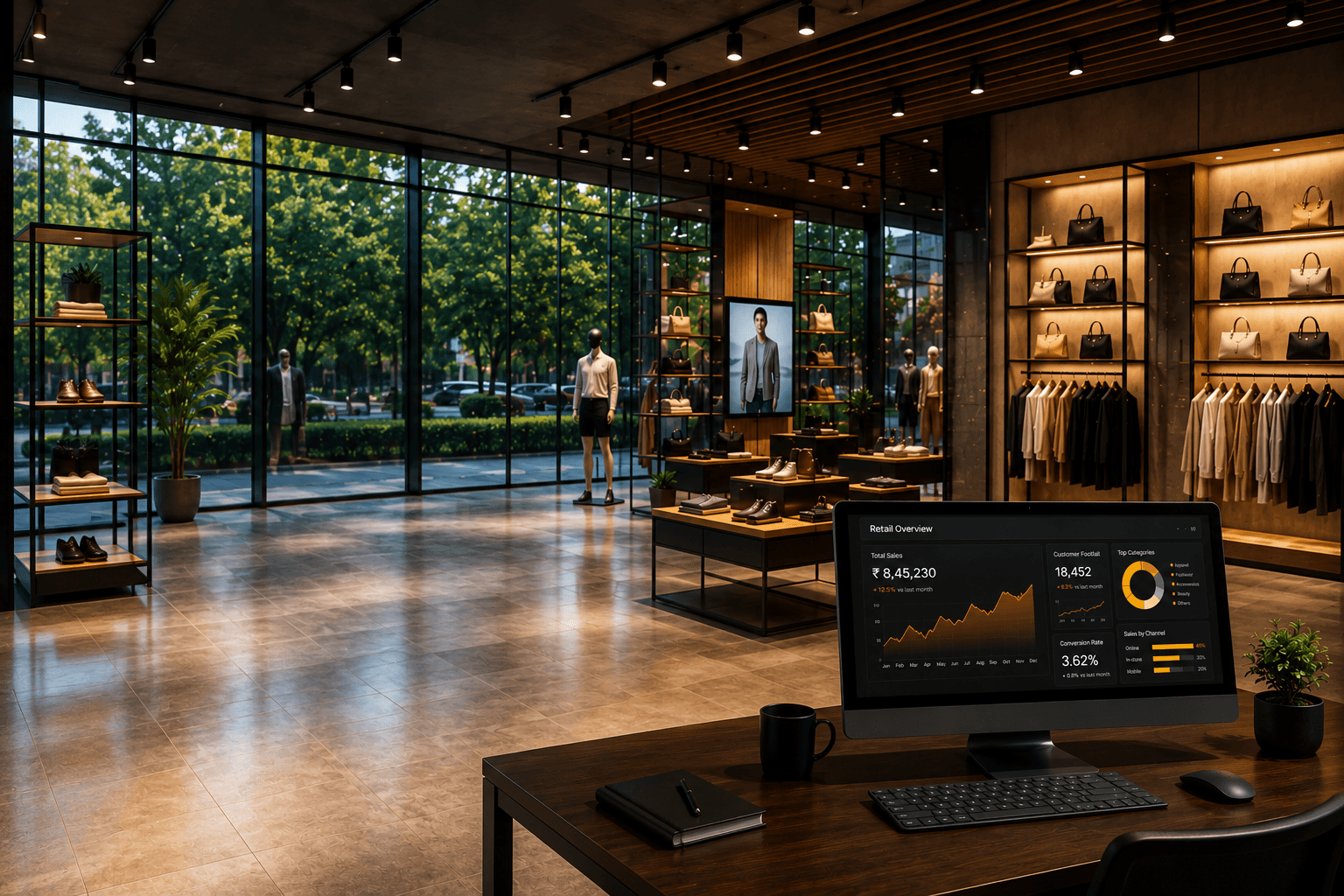
The sensing layer
Every AI system in a physical store begins with the same unglamorous question: what can this thing actually perceive? Not what does the vendor deck claim, but what signal genuinely arrives, how often, and how reliably at four o'clock on a Saturday when the store is full and half the sensors are looking at the back of somebody's coat. In practice the answer is a small and boring list — overhead vision at the entrance and over the main aisles, shelf or queue sensors where they earn their place, the point-of-sale ledger, and whatever the loyalty system already knows. Taken individually, not one of these is interesting. A door counter is a turnstile with ambition. A camera over an aisle is a very expensive motion detector. A POS record is a receipt. Retailers routinely buy one of these, discover it tells them nothing they did not already suspect, and conclude the technology does not work. The technology worked fine; the architecture was wrong. Value in retail AI does not live inside any single sensor. It lives in the correlation between them — the moment an entry, a dwell and a transaction stop being three unrelated facts and become one story about one person on one afternoon. Everything downstream depends on whether you built for that join or not.
From pixels to patterns
The modelling layer turns raw signal into structure: paths across the floor, dwell zones, queue lengths, the distinction between a shopper drifting past a fixture and one who has stopped, turned and begun deciding. Technically this is the most impressive part of the stack, and commercially it is where most deployments quietly die. The reason is a category error that is very easy to make: a heatmap feels like an answer. It is colourful, it is obviously derived from real data, it can be shown to a board, and it confirms things people already believed. But a heatmap is a picture, not a decision. Knowing that the front-right corner runs hot does not tell you whether to move the fixture, restaff the aisle, or leave it alone because hot is exactly what that corner is supposed to be. A dashboard that surfaces a pattern without prescribing an action has not removed the guesswork from your business; it has merely relocated it from the shop floor to a meeting room, where it is now slower and better dressed. The test for this layer is brutally simple and worth applying to any vendor: when it detects something, what specifically happens next, and who does it?
Prediction, not reporting
Reporting tells you what happened last week. Prediction tells you what is about to happen while there is still time to do something about it. That shift — from rear-view mirror to windscreen — is the entire justification for putting AI in a store, and it is the line most analytics products never cross. A weekly report on conversion by department is genuinely useful for planning and completely useless to the shopper currently standing in front of a mattress, unable to decide, ninety seconds away from leaving to think about it. She is the opportunity. She will not appear in the report until Monday, by which point she is a statistic rather than a sale. A model that recognises the shape of intent as it forms can trigger an offer, route an associate, or open a second till at the exact moment those actions still change the outcome. This is why latency is the metric that matters most and gets discussed least. An insight delivered in a week is history. The same insight in four seconds is revenue. The difference between them is not accuracy or sophistication — it is architecture, and it has to be designed in from the start.
The integration problem nobody budgets for
The hardest part of retail AI is not the model. It is that the answer has to arrive somewhere a human being can act on it, and that place is almost never a dashboard. It is a handset in an associate's pocket, a queue-management screen, a shelf label, a message that reaches the customer while she is still in the building. Every one of those endpoints belongs to a different system, owned by a different team, procured in a different decade, and connected — if at all — by a nightly batch job that somebody wrote and left. This is the work that gets left off the plan, and it is the reason so many pilots that "succeed" never reach a second store. The pilot proved the model could detect intent. It did not prove the organisation could do anything about it. Before signing anything, trace the full path from signal to action and name the system and the person at every hop. If any leg of that path is a nightly export, you do not have a real-time system. You have a reporting tool with a real-time model bolted to the front, and you will be paying for the model while getting the value of the report.
Doing it responsibly
None of this requires knowing who anyone is, and it is worth being precise about why. Well-built retail AI counts and characterises rather than identifies. It operates on anonymous patterns, processes and discards imagery at the edge rather than shipping faces to a server, aggregates before it stores, and treats identity as something a customer hands over deliberately through loyalty — never something inferred from their body or their face without their knowledge. There is a compliance argument for this, and it is real, but the durability argument is stronger. A system that quietly over-collects is one regulatory shift, one leak, or one local news story away from being switched off entirely, and the investment goes with it. The retailers who will still be running these systems in five years are the ones who can explain, in a single plain sentence a customer would accept, exactly what is being collected and why. If that sentence is hard to write, the problem is not your messaging. It is your design, and it is cheaper to fix now than after it appears in a headline.
What good looks like
A mature deployment is unglamorous and disappointingly specific. It watches a small number of things extremely well rather than everything badly. Every signal it collects terminates in a named action owned by a named role, and anything that does not is switched off rather than kept in case it becomes interesting. It is measured against a control — stores or periods deliberately left alone — because without one you cannot distinguish your intervention from the weather. It degrades sensibly when a camera fails, because cameras fail. And it can survive a direct question from a customer about what it is doing. None of that is a technology problem, which is precisely why so much retail AI underdelivers despite the models being fine. The organisations that win are not the ones with the best model. They are the ones that decided, before buying anything, what they would do differently once they knew.
- Individual sensors are near-worthless; correlation is where the value is.
- A heatmap that ends in a dashboard has only relocated the guesswork.
- Anonymous-by-default is a design decision, not a compliance checkbox.